Skip Navigation

Theory Marking Key

Rudiments / Intermediate Theory

Symbols / Abbreviations

Explanation

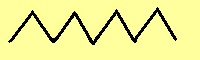
circle
error: incorrect or missing item
arrow
concern only: no marks deducted
LTleading tone
MPmisplaced (for example, misplaced clef, rest, note, accidental, etc.)
SPspelling
ST

stem:

  • a stem is missing
  • a stem and/or flag is drawn in the wrong direction or placed on the wrong side of the notehead
TIME
  • too many or too few beats in the measure
  • incorrect grouping for the time signature
VLvoice leading
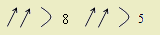
8veup arrow, 8vedown arrowplaced in the wrong octave

Harmony & Counterpoint / Analysis 

General

error: incorrect or missing item
[ ]


concern only: no marks deducted

  • an error has not resulted in a deduction of marks because it was a repetition of an earlier error and the maximum deduction has already been made
  • an error has not resulted in a deduction of marks because the item was not required and does not substantially detract from the required material
  • a suggestion or subjective comment; the examiner is offering musical advice rather than objective criticism

Please note:
On harmony & counterpoint and analysis examinations, not all errors can be marked with circles. Written comments and the symbols listed below usually also indicate problems that have resulted in deductions; however, if the comment or symbol appears in square brackets, then the mark has not been affected. Not all circles, symbols, or comments indicate a deduction of 1 mark or 0.5 mark. Markings are of varying importance and will have varying impact on the mark assigned. We endeavor to point out all objective errors but overall impression is also considered in evaluation.

Spelling/Notation

ACCmissing or incorrect accidental
BRmissing brace/bracket
ENHenharmonic spelling should be used
LTleading tone
MPmisplaced (for example, misplaced clef, rest, note, accidental, etc.)
RESTmissing rest
RPT
  • a repeat sign is drawn incorrectly
  • a required repeat sign has been omitted
SPspelling
ST

stem

  • a stem is missing
  • a stem and/or flag is drawn in the wrong direction or placed on the wrong side of the notehead
TIME
  • too many or too few beats in this measure
  • incorrect grouping for the time signature

Melodic writing
(markings focusing on any individual melodic line, including those in melody questions, the four vocal lines of SATB texture, and the two parts in couterpoint questions)

Please note:
Many of the following symbols and abbreviations are markings that depend greatly on context. They do not represent a list of "rules" or "errors" but are simply a list of markings that may be used when appropriate in specific circumstances.
end on  endonend the melody/soprano line on the tonic
LEAP

Examples of situations in which some leaps may be effective:

  • avoid making two or more leaps in the same direction larger than a third
  • where possible, approach and leave a leap from within
  • let the line move a step rather than a seventh in the other direction
LINE
  • melodic line lacks direction
  • any melodic problem that extends over a passage (rather than one problem); for example, angular line, many augmented leaps, too many leaps, etc.
PREPseventh of a diatonic seventhth chord (ii7, iii7, IV7, vi7) is not properly prepared
RES

this dissonant note or "tendency tone" should resolve; for example:

  • leading tone should resolve to tonic (RES)
  • seventh of a seventh chord is not resolved (7th RES)
  • fourth of a cadential 6/4 chord is not resolved (6/4 RES)
  • thirteenth of V13 typically moves down a third to the tonic note (13th RES)
  • non-chord tone does not resolve
STYLE
  • style diverges too greatly from the given measure
  • sonorities are included which are foreign to 18th-century style
VLvoice leading
x2 (x4, etc.)

augmented interval

  • melodic leap
  • interval outlined by consecutive pitches of a melodic line
angular
  • angular bass line
  • excessive use of root-position chords and/or chord choices too limited
range
range too narrow/repetitious

Voice leading
(markings focusing on the relationship of voices or parts to each other, including the two parts in "melody with bass at the cadence," SATB texture, keyboard realization of figured bass, and the two parts in counterpoint)

OLvoice overlapping
SEQ VL-a sequence implied by given material should be realized with sequential voice leading
zig zag
crossed parts
parallel
parallel octaves and/or fifths
hidden
hidden, exposed, direct octaves and/or fifths
contrary
contrary octaves, and/or fifths

Chord construction
(markings focusing on the "vertical" aspects of SATB or keyboard texture)

CHORDchord does not match the chord symbol or is not a chord
DBL
  • inappropriate doubling
  • in a 6/4 sonority, double the bass instead of the dissonant fourth or sixth
POS
  • for a given symbol, the student has written the chord in the wrong position
  • in a student's chord symbol, the symbol indicates the wrong position of the chord
RANGE
  • range exceeds normal range for a SATB choir
  • range exceeds the normal range in keyboard style
SPchord is spelled incorrectly
LTleading tone is doubled
3RDthird of the chord is missing
improper space

improper spacing:

  • more than an octave between soprano and alto or alto and tenor
  • range exceeds an octave in the right-hand part of a chord in keyboard style

Chord choices / Harmonic progressions

FUNCTION OF 6/46/4 chord does not function appropriately
HR

Inappropriate harmonic rhythm

  • too many strong chord changes per measure
  • harmonic rhythm is not appropriate to the time signature
  • components of the cadential 6/4 construction are separated by a bar line
  • avoid repeating a bass not or a chord of similar function over a bar line
  • strong chord change on the weak beat causes unwanted syncopation
KEYwrong key OR modulation is not observed
PROGa series of weak chord choices creating a poor harmonic progression
STYLE ?
  • style diverges too greatly from the given material
  • sonorities are included which are foreign to 18th-century style
SUSP.opportunity for suspension is ignored
WEAK

inappropriate chord choice

  • the chord does not fit with the given material
  • the chord choice does not allow for correct voice leading (for example, a seventh chord is used where it cannot resolve)
  • chord choice creates a weak harmonic progression (for example, link I and I6 with a passing vii06, not ii)

Analysis

ANALYSISincorrect or questionable harmonic analysis
KEYwrong key OR modulation is not observed
POS
  • for a given chord symbol, the student has written the chord in the wrong position
  • in a student's chord symbol, the symbol indicates the wrong position of the chord
QUAL

quality of chord is incorrectly analyzed OR analysis of quality is unclear

  • functional chord symbols use uppercase and lowercase inconsistently or illegibly
  • root/quality chord symbols in which only the quality part is incorrect
SEQobserve the sequence; the analysis should reflect the sequence and be consistent

Chorale harmonization

FERmissing fermatas
STYLEsonorities and/or construction is stylistically inappropriate to the chorales of J.S. Bach
TEXTrhythm does not fit the text OR syllable is missing or repeated

Counterpoint

IMITexpected imitation is not continued